
Cameras are learning to think for themselves. A new class of depth camera with on-board AI can measure the world in 3D and recognise what it sees — without leaning on the robot’s main computer — and that shift is quietly changing how robots are built.
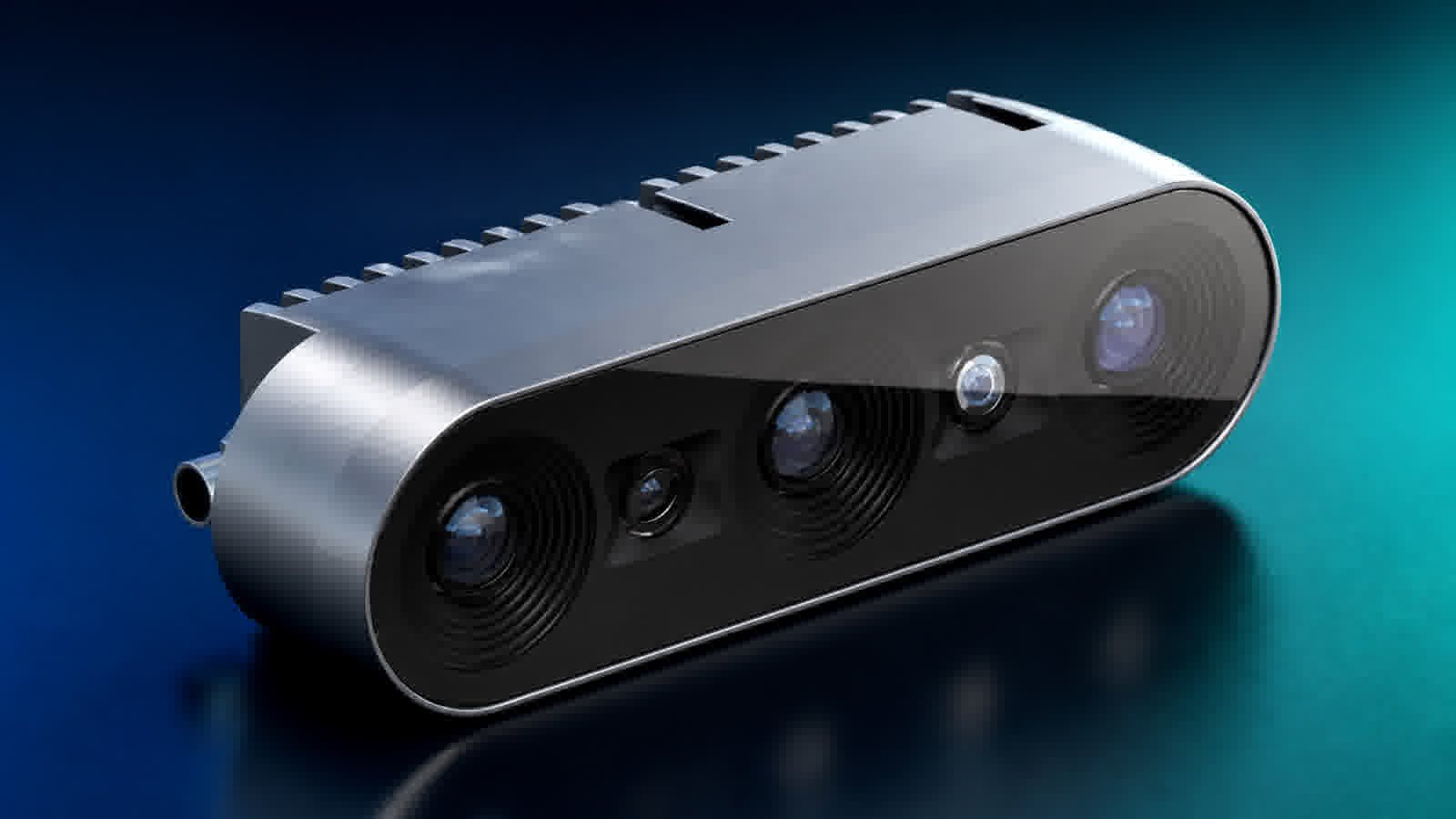
Most people know a camera as something that takes photos. A depth camera does more: it measures how far away every object is, producing a 3D map instead of a flat picture. Robots use that map to dodge obstacles and pick up parts.
What Is a Depth Camera with On-Board AI?
Depth cameras work a lot like human eyes. Two lenses sit side by side, and the small difference between the two views lets the camera calculate distance — a trick called stereo vision. Many also shine an invisible infrared (IR) light pattern and watch how it bends.
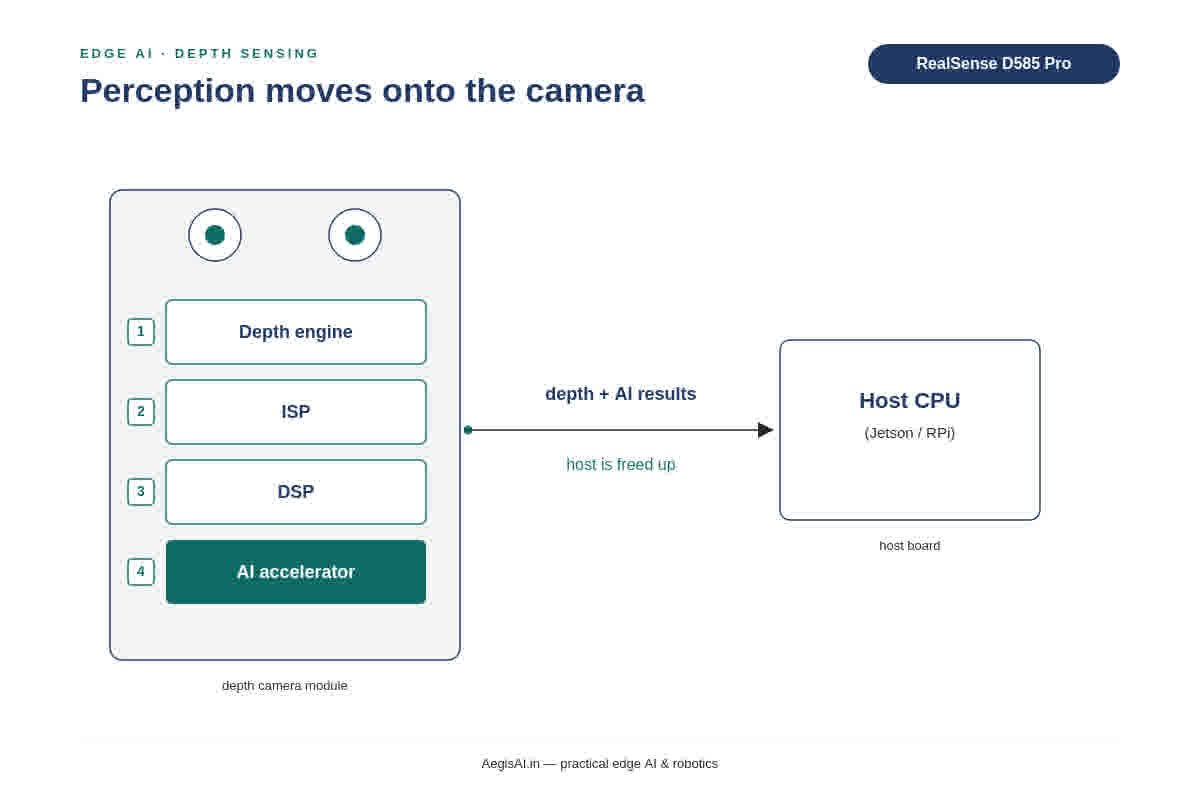
Until recently, a depth camera was mostly a sensor. It streamed raw data to the robot’s computer — often a small board like an Nvidia Jetson or a Raspberry Pi — which did the heavy thinking. That thinking is called AI inference: running a trained model to get an answer.
The new approach moves that work onto the camera. The RealSense D585 Pro and the Orbbec Physis 257g both carry their own processing brains, leaving the robot’s main computer free for planning and control.
Why Move the Brain onto the Camera?
Inside the D585 Pro sits a custom system-on-chip (SoC) — one chip that packs together the parts of a small computer: a depth engine, an image signal processor (ISP) that turns raw sensor data into a clean picture, a digital signal processor (DSP) for fast number-crunching, and AI accelerators.
Doing this on the camera has three payoffs. The host computer is freed up for navigation and control. Far less data travels between camera and computer — simpler wiring, lower power. And the camera can gain new abilities through software, without swapping hardware.
Inside the RealSense D585 Pro
RealSense unveiled the D585 Pro on June 18, 2026, at Automate, the automation trade show in Chicago. It targets humanoid robots, autonomous mobile robots (AMRs) — warehouse robots that navigate on their own — and collaborative arms (cobots) that work safely beside people.
Range is the party trick. It keeps full resolution at distances under 15 cm — close enough to inspect a screw head, with the product page quoting a 10 cm minimum — and still sees out beyond 10 metres.
Its field of view (FOV) — how wide an angle the camera sees — is 120 by 100 degrees at 60 frames per second (FPS), meaning 60 full images every second, double the frame rate of many rivals.
The hardware is built for factories and docks: IP65 protection as standard (dust-tight and resistant to water jets), built-in IR filters for reliable operation in sun and low light, and a high-speed GMSL2 link designed for vehicles and robots, plus USB-C with hardware sync.
An integrated IMU (inertial measurement unit) — a small sensor that feels motion — gives the robot a sense of balance.
Then there is the AI. At launch, the D585 Pro runs person detection in beta — it can spot people in the frame — entirely on the camera’s own SoC, with no help from the host computer.
Because the platform is software-defined, planned updates will add visual-inertial odometry (VIO) — tracking the camera’s own movement by blending images with IMU readings — plus occupancy grids (simple maps of which space is free), auto-calibration, and face detection, all delivered to existing cameras over time.
RealSense also offers on-camera Depth Compression: the camera merges each 2×2 block of pixels into a single accurate depth point, cutting the depth stream’s bandwidth by 75%. A beta program called Perception Studio gives developers early access through the RealSense 2.0 SDK (software development kit).
Orbbec’s Physis 257g: Human-Style Eyes
Orbbec answered on August 19, 2026, at the World Robot Conference in Beijing. Its Physis 257g is an RGB stereo camera — RGB meaning a normal colour camera. Its lenses sit 63 mm apart, almost exactly the spacing of human eyes.
The wide 120 by 90 degree field of view and dual 1920×1200 colour streams at 60 FPS give it broad, crisp vision. Depth range runs from 0.1 metres out beyond 10 metres.
It packs its own processing — a global shutter, an on-board ISP, and a dedicated AI depth engine — plus an integrated IMU. It talks to the robot over GMSL2, is rated IP67 (dust-tight and safe for brief immersion), and operates from -30°C to 65°C.
D585 Pro vs Physis 257g: What Matters for a Robot
For an engineer building a robot perception stack — the set of sensors and software that lets a robot understand its surroundings — four things matter most.
Close range. Both cameras get impressively near: the D585 Pro down to about 10 cm, the Physis 257g from 0.1 metres. Either can inspect parts or watch a gripper at work.
Field of view. Both offer roughly a 120-degree horizontal view (120×100 on the D585 Pro, 120×90 on the Physis), enough for whole-scene awareness.
Interface. Both use GMSL2, the low-latency thin-cable standard for robots and vehicles; the D585 Pro adds USB-C for simpler test setups.
On-camera AI. Here the D585 Pro leads: it ships with person detection on the camera, with VIO, occupancy grids, and auto-calibration on the roadmap. The Physis counters with an AI depth engine, though its strengths are imaging and multi-camera timing.
IMU and sync. Both carry an IMU. The D585 Pro offers hardware sync for multi-camera rigs; Orbbec leans on unified timestamps and microsecond-level synchronization across cameras.
Neither camera is “better” outright — they are two routes to the same destination. RealSense bets on software-defined AI; Orbbec bets on human-like optics and rock-solid multi-camera timing for embodied AI — AI that lives inside a physical body.
What This Means for the Future
Putting perception on the camera is a quiet architectural shift with loud consequences. Robots get simpler wiring, lighter loads on their main computers, and cameras that improve over time without being replaced.
For students on Jetson and Raspberry Pi boards, the same hardware can now handle bigger workloads. The depth camera is no longer just an eye but a sense organ with a mind of its own.
See this complete guide to edge AI and robotics for a wider look at how edge AI is reshaping robotics.
Hardware used in this guide
- Intel RealSense depth camera on Amazon.in
Links open search results on Amazon.in. As an Amazon Associate we earn from qualifying purchases.