Imagine pointing a phone camera at a sick tomato leaf and getting a name for the disease in seconds — no internet, no uploads, no waiting for an expert. That is the promise of on-device crop disease detection edge AI: a plant doctor small enough to live on a chip in a tool a farmer already carries. In 2026, two research papers show that promise is closer to the field than ever — and exactly why it is not there yet.
Plant disease destroys a big share of the world’s food every year, and most smallholder farms have no plant pathologist nearby. What they do have are cheap smartphones — and, increasingly, the AI needed to read a sick leaf now fits inside them. The point of on-device AI is that the thinking happens on the device itself, not in a distant cloud server: it works in a remote field with no signal, answers instantly, costs nothing per use, and never sends photos anywhere. Anyone weighing these trade-offs will find the cost, latency, and privacy math spelled out in an earlier AegisAI explainer on edge versus cloud AI.
On-Device Crop Disease Detection Edge AI: What It Is and Why It Matters
“Edge AI” means artificial intelligence that runs at the edge of the network — on the phone, the camera, or the small computer near the action — instead of in a data center. For crops, think of an offline translator app: it needs no connection because the intelligence lives in the app itself. The same idea applied to leaves lets a co-op’s technical advisor turn a field photo into a diagnosis before lunch.
Two things made this practical in 2026. Cameras on cheap phones are now sharp enough for a diagnosis, and a new generation of ultra-light models needs so little memory and power that a pocket device can run one. The catch — investigated with unusual honesty by the same researchers — is that real fields are messier than any clean photo set. Understanding the models, and the gap, is the whole story.
Two Tiny 2026 Models, Real Numbers
TinyCNN: a pocket-sized network that tells the truth
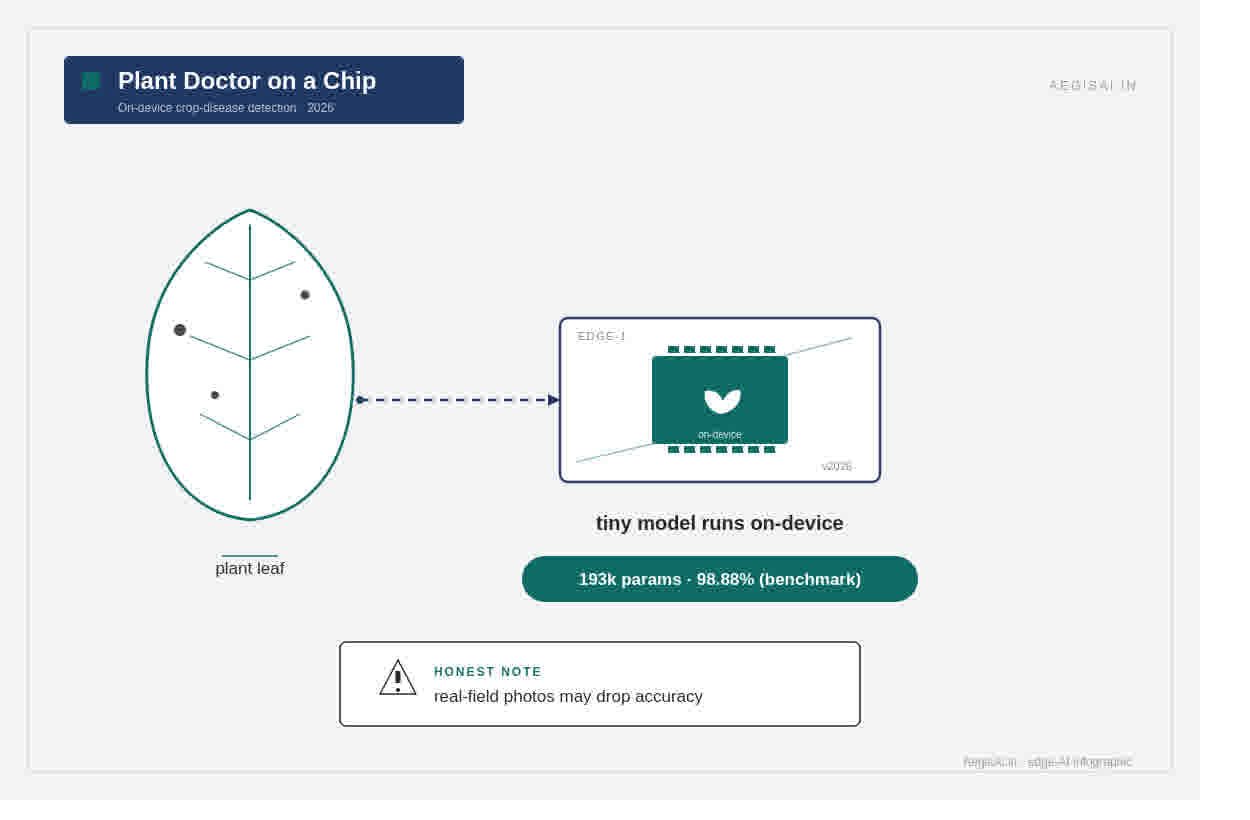
A CNN (convolutional neural network) is a pattern-recognition network, loosely inspired by how the brain processes vision, that learns what a diseased leaf looks like from example photos. TinyCNN, from a July 2026 paper, is a deliberately small CNN for on-device plant disease classification. It contains only 193,190 parameters — the small numeric settings inside a network that training tunes — and about 110.05M MACs (multiply-accumulate operations) per 224×224 photo. MACs are simply the small arithmetic steps a network performs per image; fewer of them means less energy, memory, and waiting. Roughly 110 million steps per photo is remarkably lean.
On the 38-class PlantVillage benchmark — a standard, fixed collection of labeled leaf photos used to compare systems fairly — TinyCNN reports 98.88% test accuracy. It is about 58 times smaller than ResNet18, a widely used reference network, and 11.8 times smaller than a MobileNetV2 teacher model. A distilled, further-compressed version still holds 98.81%.
What sets this paper apart is its honesty: it explicitly includes a cross-dataset robustness diagnosis. Moving from PlantVillage to PlantDoc — a collection of far messier photos taken in real-world conditions — accuracy collapsed, a gap the authors attribute to shortcut learning: the network solved the test instead of the problem, keying on background or leaf edges rather than the disease itself.
GANet: a disease detector with a thousand knobs
GANet, from an October 2026 paper, pushes smallness further. It reports just 0.001M parameters — about a thousand learnable settings — while claiming 99.99% accuracy on PlantVillage across 38 disease types.
It also reports the speeds that matter in the field. On a Raspberry Pi 4b, a credit-card-sized, low-cost hobby computer, GANet reaches about 5 FPS; on NVIDIA’s Jetson Nano, a small board built for edge AI, about 11 FPS. FPS (frames per second) is how many photos the system can analyze per second, so those speeds mean a scan of roughly one-fifth to one-tenth of a second per leaf — fast enough to point and move on. The authors frame this as real-time plant disease monitoring on low-power devices.
What It Would Take to Build One
A working system needs four ingredients. A camera sharp enough to see veins, spots, and discoloration. A device with a processor — a modern phone or a small single-board computer. A dataset: a labeled collection of photos linking each disease to the correct answer, of the kind PlantVillage provides. And an inference engine — the trained network actually reading new photos and making predictions.
The pipeline is now well documented. Train a CNN on labeled leaf photos, shrink it aggressively, then convert it to run on the target device. A January 2026 study shows how far compression can go: a pruning-and-meta-learning pipeline cut a model’s size by 78% while keeping 92.3% of its original accuracy, and the compressed model ran at about 7 FPS on a Raspberry Pi 4. The hardware barrier to a working field unit has effectively fallen; the remaining barrier is data, not silicon.
The Honest Caveat: Perfect Scores in the Lab, Messy Fields Outside
Here is the number every buyer and builder should respect: benchmark accuracy is not field accuracy. PlantVillage consists of clean, uniform, well-lit lab photos. PlantDoc-style photography — shot by real people in sunlight and shadow, against soil, weeds, and other leaves — is a different world, and models trained on the clean world stumble in it.
The TinyCNN paper documents the stumble precisely. Transferring from PlantVillage to PlantDoc produced a substantial robustness gap, and the researchers used Grad-CAM — a visualization method that highlights which parts of an image a network actually attends to — to show the network focusing on off-leaf, background regions. Classic shortcut learning: a model can ace its benchmark while having partially learned “photo background” rather than “leaf disease.”
So a 99.99% accuracy claim describes performance on a benchmark, not on a farmer’s phone in a dusty plot. It is a starting line, not a finish line. Responsible deployment means training on messy, varied field imagery — background clutter included — and validating on genuinely out-of-sample photos before anyone trusts a “plant doctor on a chip.”
The Bottom Line
On-device crop disease detection edge AI is no longer a fantasy: in 2026, models with a few thousand parameters classify dozens of diseases in fractions of a second, on hardware costing tens of dollars. The engineering race is effectively won. The scientific race — making these models survive the jump from clean datasets to real fields — is the challenge now plainly on the table, named by the very papers that set the new records.