A chip the size of a fingernail can now run the same kind of neural networks that once needed a fan-cooled board. That is the idea behind the STM32N6, the newest flagship microcontroller from STMicroelectronics, and why the STM32N6 MCU matters to anyone building smart devices. Its NPU (neural processing unit), a specialized engine for running AI models, brings edge AI — artificial intelligence that runs on the device itself instead of in the cloud — into smaller, cheaper, power-efficient hardware.
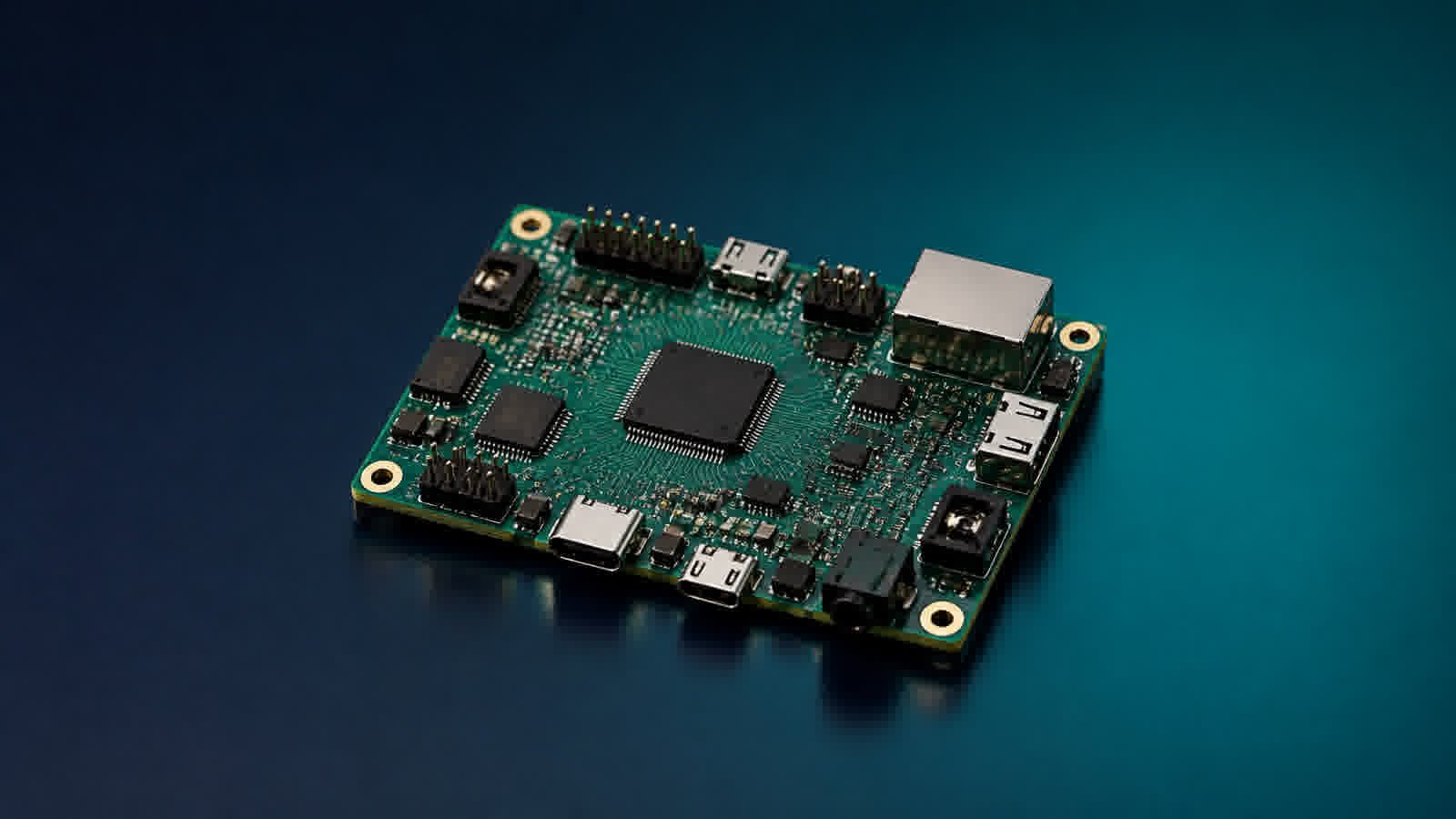
An MCU (microcontroller) is a complete miniature computer on a single chip: processor, memory, and input-output in one package, built to control devices cheaply and reliably. MCUs are everywhere — in washing machines, keyboards, and car windows. For years they were considered too weak for AI. The STM32N6 changes that: ST says it is the first mainstream, general-purpose MCU with an NPU designed in-house, and the first of its devices to ship with the Neural-ART Accelerator, an NPU delivering 600 GOPS.
600 GOPS reads like alphabet soup, but the idea is simple. GOPS stands for giga operations per second — billions of simple math operations the chip can perform every second. Neural networks are enormous chains of these operations, so more GOPS means faster AI. Even more striking is the efficiency figure: 3 TOPS/W, or tera operations per second per watt. The chip can sustain roughly three trillion operations per second while drawing about a watt of power — efficiency that makes battery-powered AI practical.
Inside the STM32N6 MCU: an NPU built for edge AI
The STM32N6 is really two processors in one. The first is an Arm Cortex-M55 core running at 800 MHz — among the fastest microcontroller cores in the industry, and the first Cortex-M55 in ST’s lineup. It handles ordinary work: sensors, communications, control logic. The second is the Neural-ART Accelerator, the NPU, which exists solely to run neural networks at speed. Together they turn a tiny chip into an AI appliance.
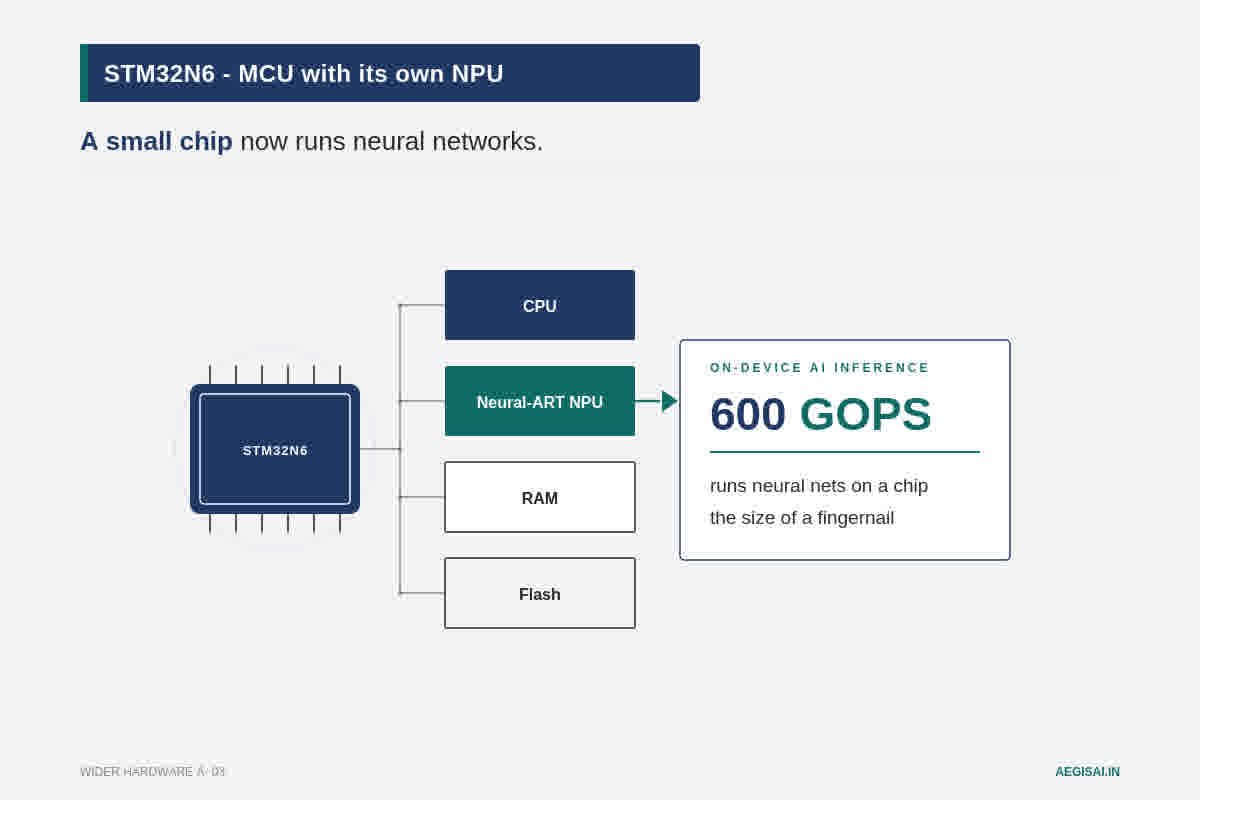
A local AI model also needs room to think. The STM32N6 carries 4.2 MB of RAM (random-access memory — the working memory where data lives while the chip computes) on-chip, the largest amount ever embedded in an STM32. That means modest vision and audio models run without external memory chips.
Where does the program itself live? The STM32N6 has no internal flash — flash being the memory that stores the program permanently, even with power off. Instead, software runs directly from an external NOR flash chip using a technique called XIP, execute in place: the CPU fetches instructions straight from the flash chip, mapped into its address space, instead of copying the program into RAM first. A small first-stage boot loader (the FSBL) wakes up at reset, initializes the memory interfaces, and hands control to the application. The flow suits cameras nicely: an on-chip image signal processor (ISP) and MIPI CSI-2 camera interface let raw sensor data feed the NPU without extra chips.
From model to machine: the deployment walkthrough
ST’s official tutorial walks through the full journey from a trained model to a running board, using the STM32N6570-DK Discovery Kit as reference hardware. The pipeline has three acts.
Act 1 — model conversion. The starting point is a trained neural network in a standard format such as TensorFlow Lite (.tflite) or ONNX. STM32Cube AI Studio, ST’s free desktop tool, converts that model into C code optimized for the Neural-ART NPU, after validating it and checking memory fit. A key optimization happens here: quantization, which squeezes a model into smaller number formats — many models train in 32-bit numbers but run fine on 8-bit integers with a tiny accuracy loss. That shrinks the model and speeds it up, essential on a chip with megabytes rather than gigabytes of memory. For ready-made starting points, ST maintains the STM32 Model Zoo — the tutorial uses a MobileNetV2 image classifier, a CNN (convolutional neural network, the architecture behind image recognition).
Act 2 — firmware generation. Generated AI code alone is not enough; the chip needs full firmware — the surrounding software that initializes clocks, peripherals, and memory. STM32CubeMX, ST’s code generator, creates this from a board template for the STM32N6570-DK, wiring up CPU and NPU clocks, the XIP memory interfaces, and the NPU’s access privileges. It generates the FSBL boot loader and the main application as two linked sub-projects.
Act 3 — flash and run. The finished binary is written to the external NOR flash with STM32CubeProgrammer. On boot, the FSBL initializes the external memories, the application executes in place via XIP, and inference begins, with results printed over a serial connection every five seconds.
When an MCU with an NPU beats a single-board computer
Engineers arriving from Raspberry Pi or Jetson territory may ask: why not just use a bigger board? A single-board computer (SBC) is a full miniature computer running an operating system, like a Raspberry Pi — whereas an MCU runs one program directly. For many AI products, the MCU-plus-NPU combination now wins on four axes.
Power. At 3 TOPS/W, the STM32N6 runs serious models within a battery budget. An SBC typically draws watts; an MCU counts its appetite in milliwatts. For wearables, sensors, and hand-held devices, that difference decides whether a product is viable at all.
BOM cost. BOM stands for bill of materials — the complete list and cost of every part in a product. A single chip integrating CPU, NPU, and megabytes of RAM replaces a board, a separate processor, external memory chips, and often a fan and power supply. At production volumes, removing even one part multiplies into real money.
Hard real-time. An SBC’s operating system can introduce unpredictable delays. An MCU can run with no OS, or with a real-time operating system (RTOS) — software that guarantees responses within fixed deadlines — essential for motor control, safety interlocks, and industrial automation.
No Linux at all. No operating system means no boot time, no OS updates to patch, no kernel to tune. The device is a reliable black box that does one job for years. For many manufacturers, simpler is safer.
This is not an argument that SBCs are obsolete. Bigger models, rapid prototyping, and rich software ecosystems remain SBC territory — and for GPU-class edge AI, NVIDIA’s Jetson family answers that need, as covered in this look at the Jetson Orin Nano. But for high-volume, power-constrained products doing one focused AI job, a microcontroller with its own neural engine is now the rational choice — and that is exactly the niche the STM32N6 occupies.
The takeaway
ST’s first mainstream general-purpose MCU with an in-house NPU is a milestone, not a gimmick: 600 GOPS of inference at 3 TOPS/W, an 800 MHz Cortex-M55, and 4.2 MB of on-chip RAM, with a toolchain that takes a model from framework to flash in three steps. Neural networks no longer demand a fan-cooled board. For a growing class of products, they now fit in the palm of a hand.
For the technical reader: verified toolchain and pipeline
Board: STM32N6570-DK (Discovery Kit) Pipeline: AI model (.tflite / .onnx) -> STM32Cube AI Studio (validate + quantize + generate C) -> STM32CubeMX (FSBL + Appli project, XIP memory config) -> STM32CubeProgrammer (flash external NOR, MX66UW1G45G loader) -> inference output over USART @115200 baud. Minimum tool versions (ST tutorial): STM32CubeMX 6.17.0, STM32CubeN6 1.3.0, STM32CubeIDE 2.0.0, STM32Cube AI Studio 1.2.0, STM32CubeProgrammer 2.22.0.
Hardware used in this guide
- STM32 Nucleo development boards on Amazon.in
Links open search results on Amazon.in. As an Amazon Associate we earn from qualifying purchases.