NVIDIA has started shipping its most powerful robot brain yet. Jetson AGX Thor is a compact computer that rides inside a machine and lets it perceive, plan, and act on its own — with no data center in the loop.
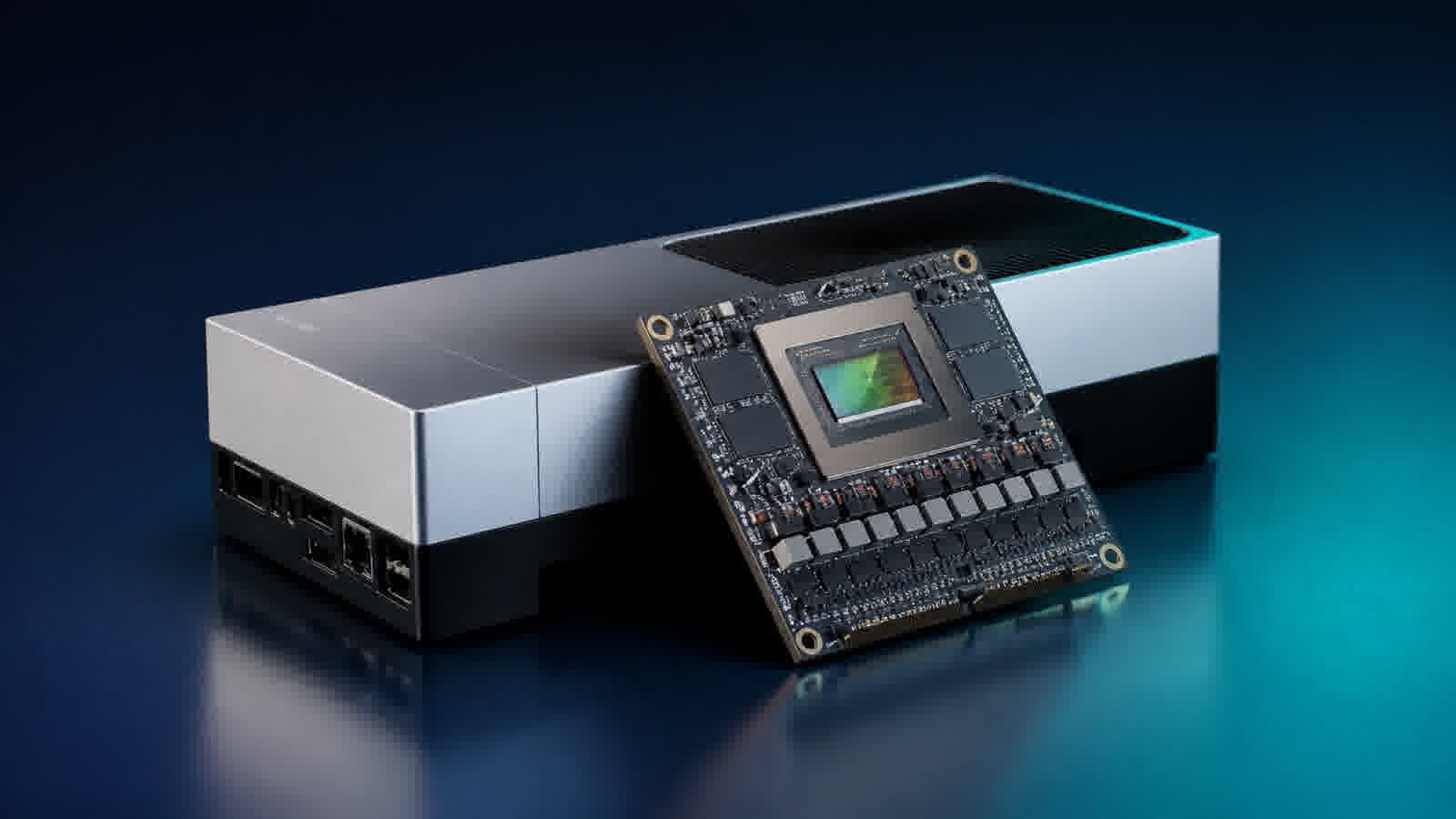
For anyone following edge AI, the Jetson AGX Thor physical AI story just passed a milestone: the Jetson AGX Thor Developer Kit and the Jetson T5000 production module are now generally available through NVIDIA’s authorized distributors, per NVIDIA’s announcement.
As of 2026, the platform is out of the lab. It now tops a lineup whose entry level is the Jetson Orin Nano 2, covered on AegisAI recently. Here is what it can do — and what is still vendor marketing.
What is physical AI?
“Physical AI” means AI that acts in the real world instead of just producing text or images. A chatbot writes an answer; a physical AI system watches a room, forms a plan, and moves a robot’s hands and legs to carry it out.
NVIDIA has pushed this idea since March 2024, when it announced the Thor chip alongside Project GR00T, a family of models built to give general-purpose humanoid robots common sense.
The goal is the “generalist robot” — one machine trained for many tasks in many environments instead of a specialist locked to a single job. That takes hardware for every motor and sensor, real-time control to keep the robot stable, perception so it understands what it sees, and reasoning so it can follow complex instructions.
What makes the Jetson AGX Thor tick?
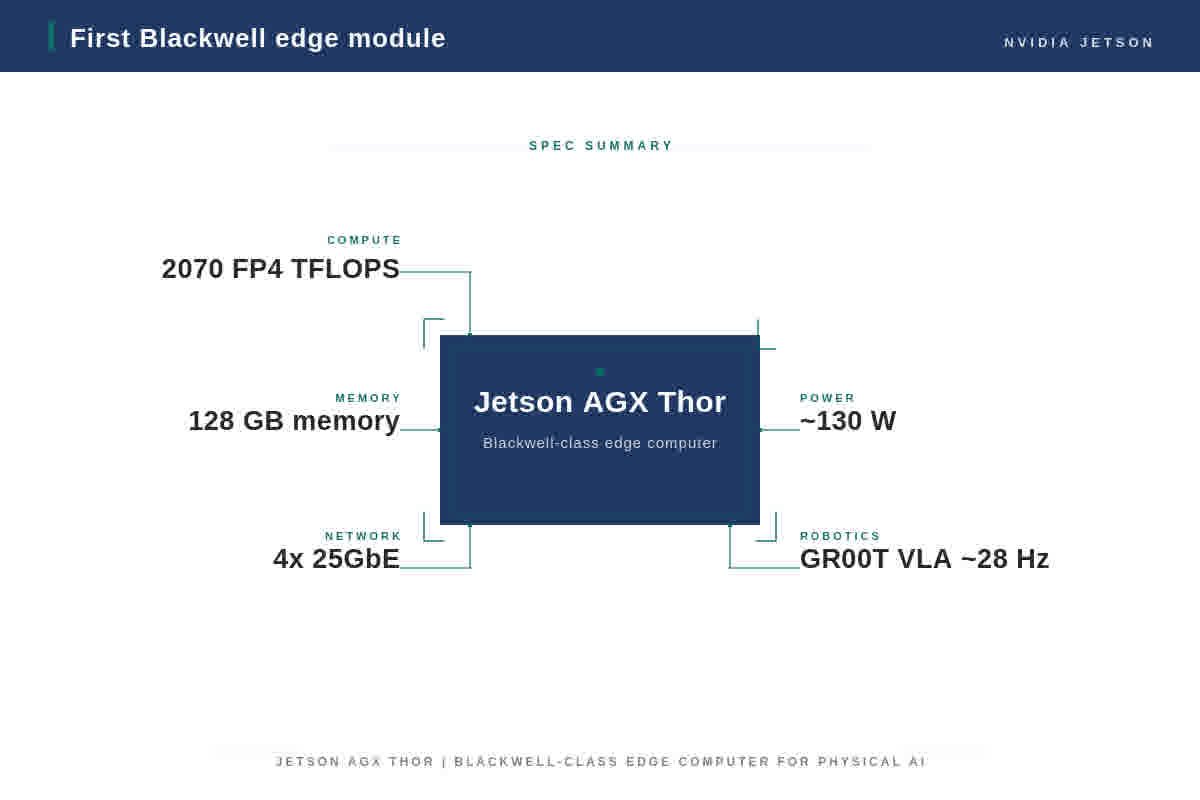
At the center sits a Blackwell GPU — NVIDIA’s newest chip architecture, named after mathematician David Blackwell, and the same architecture behind the company’s newest data-center chips. On Thor it delivers up to 2,070 FP4 TFLOPS inside a 130-watt power envelope.
FP4 means four-bit floating point — a very compact way to store numbers during AI calculation; smaller numbers mean faster math. TFLOPS means trillions of floating-point operations per second, the standard yardstick for AI hardware. A next-generation Transformer Engine — the machinery that speeds up generative AI models — switches between FP4 and FP8 automatically.
The T5000 module pairs a 2,560-core Blackwell GPU with 128 GB of unified memory: one shared pool both the CPU and GPU use directly, so data is never copied between banks — critical for a robot that must respond in milliseconds.
Around it sit a 14-core Arm Neoverse-V3AE CPU (server-class cores) and a third-generation PVA (Programmable Vision Accelerator, a dedicated vision engine), plus video encoders, decoders, and an optical-flow accelerator. AGX is NVIDIA’s label for its flagship Jetson module line — Thor is the top of the tree.
NVIDIA also brought MIG (Multi-Instance GPU) to Jetson for the first time. MIG splits one GPU into isolated slices with dedicated resources, so a robot’s safety-critical control job can reserve its own slice for guaranteed performance while less urgent AI tasks run in parallel.
Built for high-speed sensing
Robots generate a flood of sensor data: cameras, motion sensors, motors, and more. The developer kit is wired for that — a high-speed QSFP port with four 25-gigabit Ethernet links (a “gigabit” is a billion bits per second), a 5-gigabit Ethernet port, USB 3.2, Wi-Fi 6E, CAN headers (the wiring standard robots use), and a 1 TB NVMe SSD.
A feature called Camera over Ethernet streams sensor data straight into GPU memory, cutting latency and offloading the CPU.
Why robots need this much power: VLA models and GR00T
Modern robot brains are VLA models — vision-language-action models. The model watches what the camera sees, reads an instruction in plain language, and outputs the movements needed to carry it out. NVIDIA’s GR00T N1 family is its open line of VLA models for humanoids, released on GitHub with code under the permissive Apache 2.0 license.
The latest version, GR00T N1.7, is a telling stress test for Thor. NVIDIA’s benchmark notes on the Isaac-GR00T repository report it runs at about 28 Hz — 28 decision cycles per second — on a Jetson AGX Thor with TensorRT (NVIDIA’s software that optimizes models for its chips).
For comparison, the same model reaches about 40 Hz on a full-size RTX PRO 6000 server GPU.
Acting 28 times a second is responsive enough for manipulation and navigation — and an edge board landing within striking distance of a server card shows what Thor brings to the field.
Where the Jetson AGX Thor physical AI goes to work
That onboard intelligence has already drawn the biggest names in robotics. NVIDIA lists Agility Robotics, Amazon Robotics, Boston Dynamics, Caterpillar, Figure, Hexagon, Medtronic, and Meta among early adopters, while 1X, John Deere, OpenAI, and Physical Intelligence are reportedly evaluating the platform.
Agility — builder of the Digit humanoid — plans Thor as the onboard computer for the sixth generation of Digit, and Boston Dynamics is integrating Thor into its Atlas humanoid, per DataCenterDynamics.
“With unmatched performance and energy efficiency… Jetson Thor is the ultimate supercomputer to drive the age of physical AI and general robotics,” said NVIDIA founder and CEO Jensen Huang at the announcement.
GR00T needs at least 16 GB of memory just to load; Thor’s 128 GB runs perception, reasoning, and control models at once.
Software, price, and the fine print
Thor runs JetPack, NVIDIA’s software bundle for Jetson boards — the Linux operating system plus AI tools in one package.
JetPack 7 ships with Ubuntu 24.04 LTS and aligns with SBSA, the standard architecture for Arm servers, so code moves between server GPUs and Thor easily. The wider stack rides along: Isaac for robotics, Metropolis for vision AI, Holoscan for sensor processing.
The Jetson AGX Thor Developer Kit — T5000 module, carrier board, heatsink, and power supply included — is priced at $3,499; production T5000 modules start near $2,999 at 1,000-unit volume.
This is professional equipment, not a hobby board.
One honest caveat: NVIDIA says Thor delivers up to 7.5x the AI compute and 3.5x the energy efficiency of its predecessor, the Jetson AGX Orin. Impressive — but the multipliers come from NVIDIA’s own labs, as do the “up to 5x faster generative reasoning” claims. Treat them as vendor claims until third parties confirm.
Thor versus the Jetson Orin Nano 2
The Jetson Orin Nano 2, announced in August 2026 and covered on AegisAI earlier, targets makers and students with 78 TOPS (trillions of operations per second) of AI compute and 8 GB of memory. Thor targets professional robotics with up to 2,070 FP4 TFLOPS and 128 GB.
The figures use different measurement conventions, so they do not divide cleanly — but the class gap is real. NVIDIA has sold Jetson boards since 2014, and these two bracket the family: one nimble entry machine, one flagship built for humanoids.
The bottom line
Jetson AGX Thor moves physical AI from theory into hardware you can buy. The specs are extraordinary on paper, the adopter list is the who’s who of robotics, and the GR00T benchmark suggests real capability. What remains is outside validation — and the first wave of robots shipping with Thor inside.
Hardware used in this guide
- NVIDIA Jetson developer kits on Amazon.in
- M.2 2280 NVMe SSD on Amazon.in
Links open search results on Amazon.in. As an Amazon Associate we earn from qualifying purchases.