
The rules that keep people safe around factory robots just got their biggest rewrite in fourteen years. The ISO 10218 2025 collaborative robot safety standards — the international rules for robots that work beside people — now demand more from manufacturers, integrators, and the plants that deploy them.
ISO stands for the International Organization for Standardization, which coordinates safety rules used worldwide. ISO 10218 has two parts: Part 1 covers the robot itself; Part 2 the installed system in a workplace.
Part 1 reached Edition 3 in February 2025, Part 2 its second edition, replacing the 2011 editions.
What the ISO 10218 2025 collaborative robot safety rewrite changes
The revision is dense — Part 2 alone grew from 72 pages to 223. Four changes matter most.
First, the old rulebook for human-robot contact was folded into the main standard and turned from advice into a requirement. Second, robots are now sorted into two classes with different safety demands.
Third, the safety-rated monitored stop has a new name: monitored standstill. Fourth, network security is part of the safety case for the first time.
Two parts, two jobs: the robot and the cell
ISO 10218-1:2025 tells robot manufacturers what they must build in before a machine leaves the factory: emergency stop functions, safety-rated speed monitoring, and documented stop performance.
ISO 10218-2:2025 tells the integrator, who wires the robot into a production cell with tooling, sensors, and guards, how to assess risk, choose safeguards, and prove the system safe.
The divide remains: the robot must be safe by design, and the application must be safe in use.
The four collaborative modes — and a new name for an old function
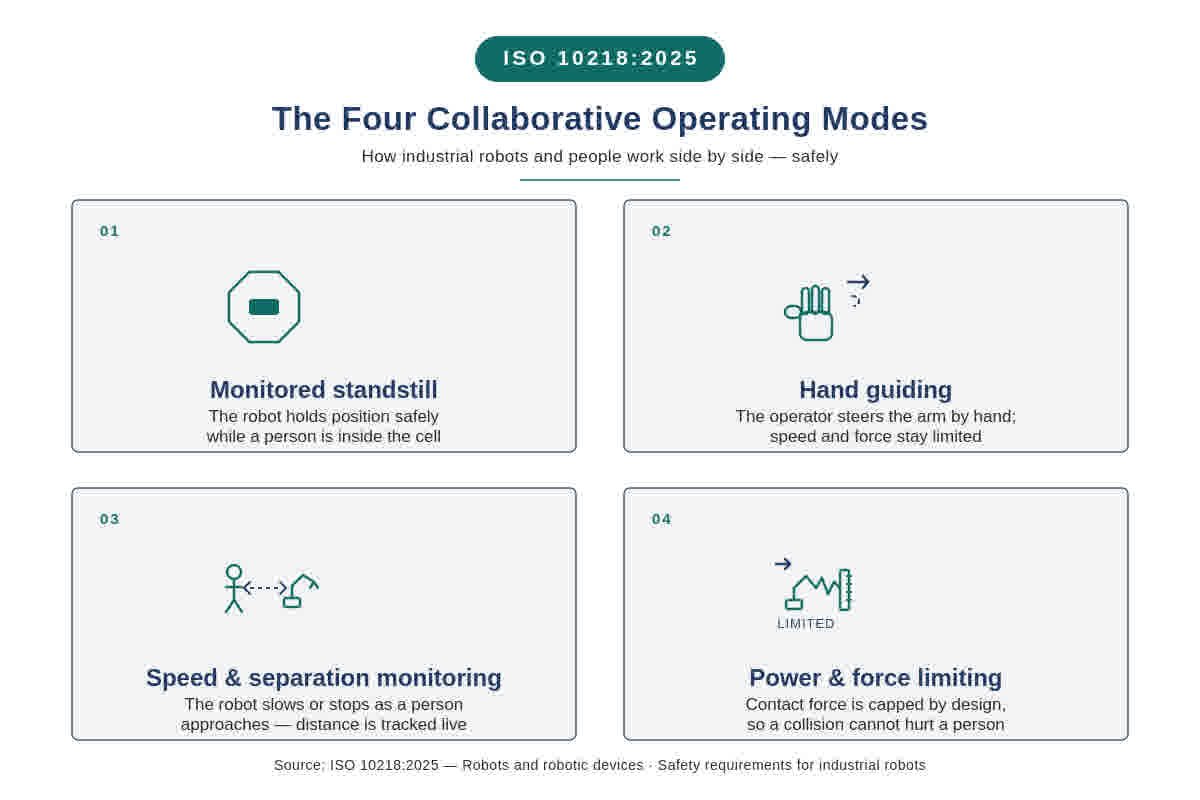
A “cobot” — short for collaborative robot — is an industrial robot designed to work safely in the same space as a person. The 2025 standard keeps all four collaborative modes, now called collaborative applications.
Compliance, in other words, belongs to the installed application — its tooling and the operator’s reach — not to the robot alone.
Monitored standstill
The robot pauses when a person enters its workspace and resumes when the person leaves. The simplest mode, it now carries a new name: it was the safety-rated monitored stop in previous editions.
Hand guiding
A person physically moves the robot arm by hand, typically guiding it along a path it will later repeat.
Speed and separation monitoring
Safety-rated sensing — laser scanners, cameras, or radar — continuously measures the distance to any person, and the robot slows or stops when someone comes close.
Power-and-force limiting (PFL)
This is the mode most people picture when they hear “cobot.” The robot detects contact through torque sensing, current monitoring, or dedicated force sensors, and keeps any collision’s force and pressure within limits considered safe for the body region struck — even while continuing to move. The modes are not mutually exclusive; one cell can combine several.
Force and pressure: from advice to hard requirement
The biggest structural change concerns ISO/TS 15066 — a technical specification (TS), ISO’s lighter-weight document type — which has defined human-robot contact limits since 2016: 29 body areas grouped into 12 body regions.
The limits carry separate values for transient contact (a brief impact) and quasi-static contact (a clamping scenario).
The 2025 revision moves those limits into ISO 10218-2 and makes validation mandatory: any installation using power-and-force limiting must measure and verify real contact forces and pressures against the limits. What was guidance from a separate document is now a required part of compliance with the core standard.
New robot classes: Class I and Class II
The 2025 standard introduces a formal two-tier robot classification. A Class I robot is small: a manipulator mass of 10 kilograms or less, a maximum force of 50 newtons (N), and a top speed of 250 millimetres per second (mm/s).
Because it is so limited, its safety functions may be built to a lighter reliability rating: PL b or SIL 1. Everything else is Class II — bigger, faster, or stronger — and its safety functions must meet the higher bar of PL d or SIL 2.
PL stands for performance level, a rating from a to e of how reliably a safety circuit works (ISO 13849-1); SIL stands for safety integrity level, the equivalent rating on the IEC 62061 route.
In plain terms, a Class II robot’s protective circuits must be markedly more dependable — with redundancy and self-checking — than a Class I robot’s.
Safety now includes the network
For the first time, the standard treats cybersecurity as part of robot safety. New clauses require manufacturers to protect safety functions against malicious modification.
The change reflects the modern connected factory, where robots talk to plant networks and cloud services. A safety case that ignores the network is no longer complete.
The United States follows: ANSI/A3 R15.06-2025
American readers will see a new designation in their compliance files. ANSI — the American National Standards Institute — and A3, the Association for Advancing Automation, now publish ANSI/A3 R15.06-2025, the US adoption of both new ISO parts.
Released in September and October 2025, the set includes a US-only Part 3 for end users, with no ISO equivalent, and replaces the ANSI/RIA R15.06-2012 standard that most US documentation still cites.
Existing cells that were compliant when built do not automatically need re-certification; new cells and significant modifications should follow the 2025 editions.
What this means in practice
For manufacturers, the task is to document which collaborative technologies each robot supports and under what conditions. For integrators, measured force and pressure values are part of the compliance file, not a nice-to-have.
For everyone, the questions to ask early are simple: is the robot Class I or Class II, and does the safety case cover the network?
The direction is clear: collaborative robotics is being held to the same rigorous standards as traditional industrial automation. For more plain-language robotics explainers, AegisAI.in keeps engineers and makers current on edge-AI and automation.
The details are in the public record: ISO’s project page and inmotion’s comparison guide document the 2025 revision, the four modes, and the US adoption.